
STRETCHY WRAPS

Stretchy wraps comprise one long piece of fabric, akin to t-shirt fabric around 5m in length, which is wrapped around your body and keep your little one secure, snug and close – the best place to be after nine months in utero!
Stretchy wraps are usually pre-tied. In other words, you tie it around you before tucking baby in. The main advantage to this is that you can tie it on in the morning, and if you want to, keep it on all day, popping baby in and out as necessary – you can also have it tied before you go out. In this way, stretchy wraps can be an amazingly helpful tool in those first challenging and precious few weeks. There are no buckles, rings or fasteners, just soft jersey fabric.
In general, most stretchy wraps are used for front carrying only, with baby being placed in an upright, tummy-to-tummy position. One size fits most wearers and stretchy wraps can be very comfortable and supportive for both wearer and baby, particularly as they are so soft. They’re a great carrying option for newborns up to around 1 year.
BUCKLE CARRIERS

Buckle carriers, or soft-structured carriers, are versatile and relatively easy to learn. The basic design of a buckle carrier is a front panel, a padded waist strap and two padded shoulder straps, all of which are adjustable to achieve a comfortable fit, and secure with buckles.
Buckle carriers can be supportive and baby can be worn on the front or back, sometimes on the hip too. Buckle carriers are probably the most popular design of carriers. Some can be used from newborn, some can be used from 3-4 months upwards. With some designs, the shoulder straps can cross on the back to provide extra support.
A really good buckle carrier will allow you to carry your little one in such a way as to be respectful of their physiology. Their back should be soft, yet supported – not stiff or rigid. Their legs should be supported all the way along the thigh, to the knee pit, with heir bottom lower than their knees – traditionally, this is called the ‘spread squat position’ or ‘M’ position, but is often defined now as the ‘hip healthy position’. Baby’s head should be free, clear and unobstructed.
Buckle carriers are versatile and relatively easy to learn. The basic design is a front panel, where baby is ‘seated’ in an upright position, a waist strap and two padded loop shoulder straps, all of which are adjustable to achieve a comfortable fit, and secured with buckles.
Buckle Carriers can be supportive and baby can be carried on your front or back, and sometimes on the hip too. Buckle carriers are probably the most popular design of baby carrier. Some carriers can be used from newborn, and some from around 3-4 months onwards. Toddler buckle carriers are growing in popularity and most can be used from around 18 months up to preschool age.
Although comprising a basic design, baby buckle carriers do vary slightly, mostly in terms of whether they are structured or unstructured. Most carriers are structured – in other words, the waist and shoulder areas are padded with either foam or firm padding. Examples of structured carriers include Tula Baby Carriers and Ergobaby Carriers.
Unstructured carriers are fewer in number, but are still very popular. They tend to have no padding in the waist section, and only very lightly padded shoulders (if at all).
With some designs, the shoulder straps can cross on the back to provide extra support (X-shape on the back). Other designs offer ‘rucksack-style-straps’, where the shoulder straps loop over the shoulders and under the arms, with a clip securing the straps either across your chest or back.
A really good buckle carrier will allow you to carry your little one in such a way as to be respectful of their physiology. Their back should be soft, yet supported – not stiff or rigid. Their legs should be supported all the way along the thigh, to the knee pit, with heir bottom lower than their knees – traditionally, this is called the ‘spread squat position’ or ‘M’ position, but is often defined now as the ‘hip healthy position’. Baby’s head should be free, clear and unobstructed.
Buckle carriers are versatile and relatively easy to learn. The basic design is a front panel, where baby is ‘seated’ in an upright position, a waist strap and two padded loop shoulder straps, all of which are adjustable to achieve a comfortable fit, and secured with buckles.
Buckle Carriers can be supportive and baby can be carried on your front or back, and sometimes on the hip too. Buckle carriers are probably the most popular design of baby carrier. Some carriers can be used from newborn, and some from around 3-4 months onwards. Toddler buckle carriers are growing in popularity and most can be used from around 18 months up to preschool age.
Although comprising a basic design, baby buckle carriers do vary slightly, mostly in terms of whether they are structured or unstructured. Most carriers are structured – in other words, the waist and shoulder areas are padded with either foam or firm padding. Examples of structured carriers include Tula Baby Carriers and Ergobaby Carriers.
Unstructured carriers are fewer in number, but are still very popular. They tend to have no padding in the waist section, and only very lightly padded shoulders (if at all).
With some designs, the shoulder straps can cross on the back to provide extra support (X-shape on the back). Other designs offer ‘rucksack-style-straps’, where the shoulder straps loop over the shoulders and under the arms, with a clip securing the straps either across your chest or back.
WOVEN WRAPS

Woven wraps are similar to stretchy wraps in that they comprise one long piece of fabric with no buckles, fasteners or rings. Woven wraps can be tied in different ways for different carries. They differ from stretchy wraps in that woven wrap fabric is far more supportive. It has a slight diagonal stretch, making it firmer – supportive enough to hold a heavy toddler.
A woven wrap sling can work for all sizes and ages, from one-week old until your child grows out of being carried. You can adjust the sling to carry your baby in different ways as they grow and develop. Once you wrap it around, the sling holds your baby safely and securely in a way that promotes their development, is respectful to baby’s physiology and is healthy for their hips.
Woven wraps can be tied for front, back and hip carries. If you’ve loved using a stretchy wrap for your baby, then a woven wrap will allow you to continue wrapping with a larger, heavier baby, toddler and child.
Woven baby wraps are a beautiful way to carry your little one. There is a sort of ritual to wrapping; the cloth, the movements, the finish. It can seem daunting – the long length of fabric, without structure, and yes, there is a learning curve with it, for sure. However, the lack of structure is exactly what makes a woven wrap so versatile. It can be used with even the smallest babies all the way to preschoolers. The very same wrap. Which also means a woven wrap can be the most economical, cost-effective sling to use.
RING SLINGS
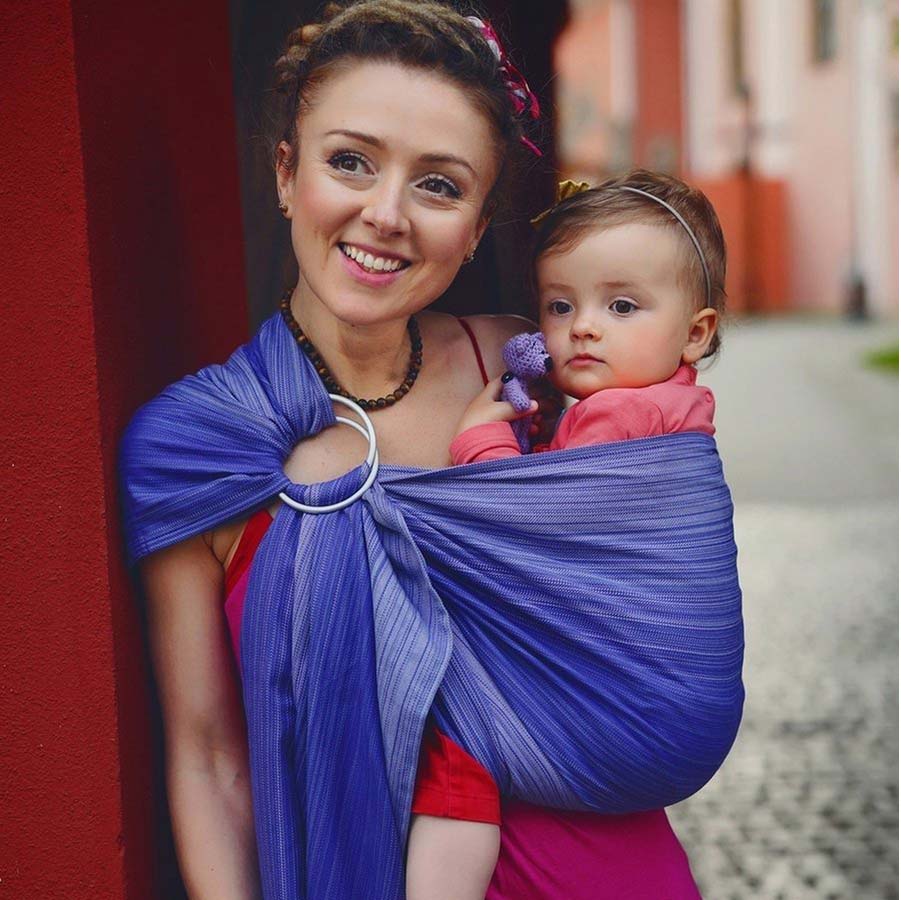
Ring slings are awesome and are great for newborns and toddlers alike.
A ring sling comprises a long piece of woven wrap fabric with 2 aluminium rings sewn into one end. The length usually ranges from 1.7m to 2m. The tail (end of the woven wrap) is usually asymmetric.
Really good ring slings are usually made from woven wrap fabric, sewn through two aluminium rings. As such they:
- have slight diagonal stretch, making the fabric firm to use – supportive enough to hold even a heavy toddler;
- are most often found in 100% cotton options (cotton is easy to care for, easy to wash and dry and suits babies of all ages);
- can be found in a variety of colours, designs, lengths, and weaves.
MEH DAIS
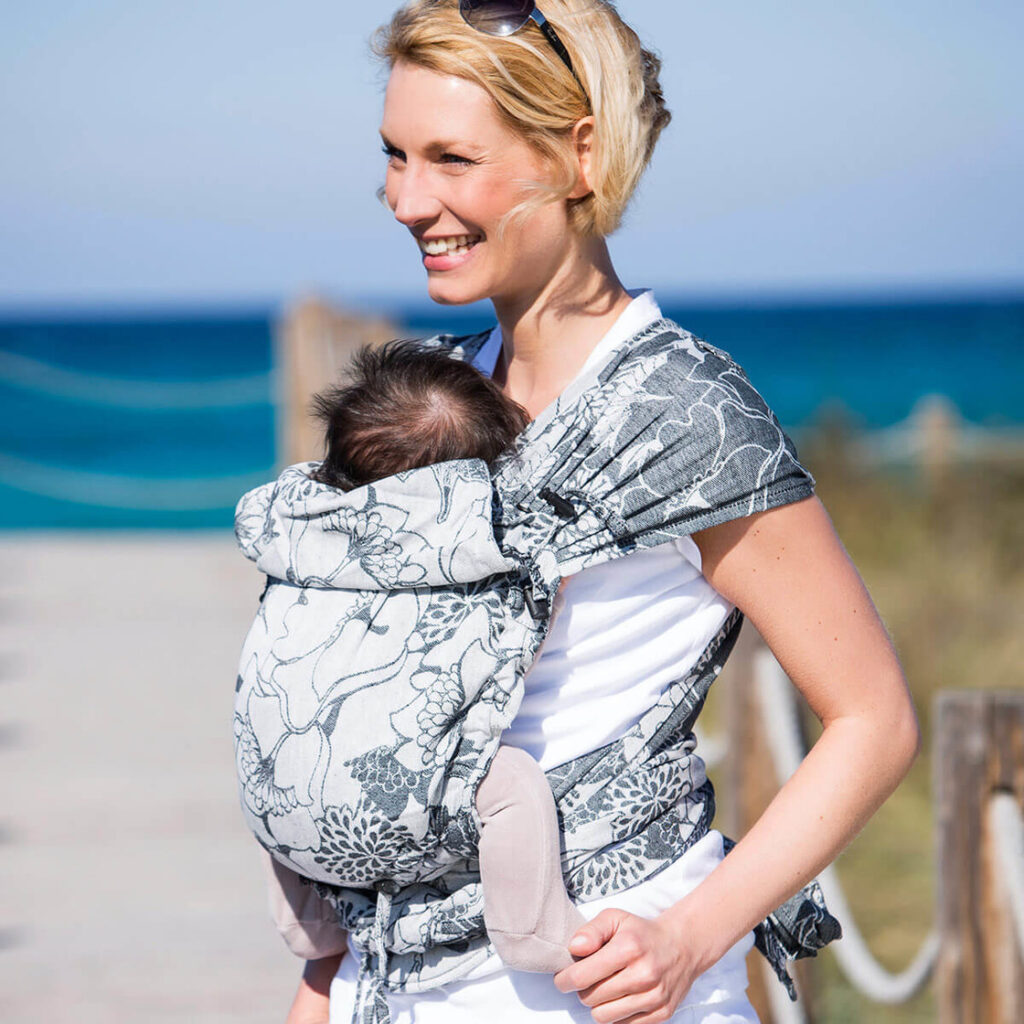
The basic design of a meh dai is a main panel with two pairs of straps. One pair ties ties around the waist, securing with a knot, and the other pair, sits on the shoulders and crosses on the wearers back then around baby, distributing the weight evenly across the shoulders, back and hips.
It is very simple in design, yet very supportive in style. There are no buckles, or rings, just fabric, and sometimes padding in the shoulder and waist straps for extra support. They can be used for front, hip and back carries, and most can be used from newborn through to toddlerhood and beyond.
They are a wonderful option if you’d like a little more structure for ease of use, but want something mouldable, soft and wrap-like.
There are lots of variations between the brands. Some have wrap-strap shoulders, some have padded shoulder straps and waist straps, some even have a combination of both.
HALF BUCKLE CARRIERS
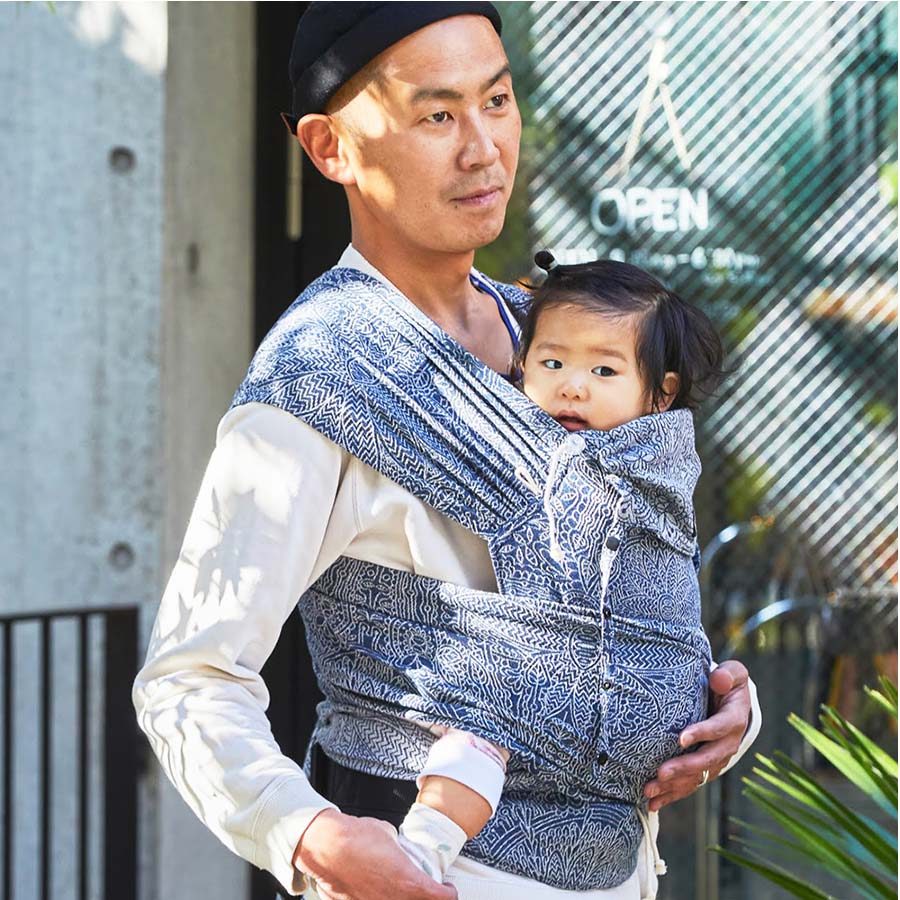
Halfway between a full buckle carrier and a meh dai carrier, a half buckle carrier offers the ease of a clip buckle at the waist, with the adjustability of long shoulder straps for a truly snug fit, without the reaching for back or side clips. Front, hip and back carrying, most are suitable from newborn. They are a wonderful option if you’d like a little more structure for ease of use, but want something mouldable, soft and wrap-like. There are lots of variations between the brands. Some have wrap-strap shoulders, some have padded shoulder straps and waist straps.
There are lots of variations between the brands. Some have wrap-strap shoulders, some have padded shoulder straps and waist straps.